
Tools Homepage › Study Abroad › Studying in Thailand
K12 Academics · Study Abroad Guide

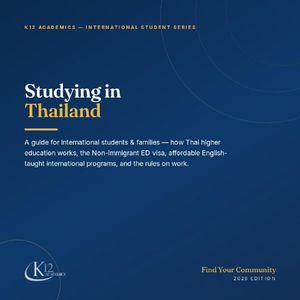
Studying in Thailand

A guide for international students & families — how Thai higher education works, the Non-Immigrant ED visa, affordable English-taught international programs, and the rules on work.
System
Chulalongkorn, Mahidol, Thammasat
Visa
Non-Immigrant ED (Education)
On arrival
90-day reporting; annual extension
Tuition
International ~THB 117k–282k/yr
English
international programs
Work
Prohibited on ED visa
Studying in Thailand cover
Free PDF · Read or print offline

Studying in Thailand

The full K12 Academics guide, formatted to read comfortably on screen or print as a clean reference. Free, no sign-up.

View the PDF →Download

Thailand has become one of Asia’s most accessible study destinations — with respected universities (Chulalongkorn, Mahidol, Thammasat), a growing set of English-taught “international programs,” and a famously low cost of living. Its top universities rank among Asia’s best, and international programs undercut Western fees by 50–70%. Non-EU students study on a Non-Immigrant ED (Education) visa, arranged with the university’s acceptance letter. One honest note up front: working is strictly prohibited on the ED visa. This guide gives a clear overview — confirm details with the Thai embassy and your university.

Step 1 of 11

Understand Why Students Choose Thailand

Thailand offers affordable, English-taught international programs; respected universities; a very low cost of living; a safe, welcoming culture; and an international campus community — in one of Asia’s most popular destinations.

Affordable — + English programs
Respected universities — Chula, Mahidol
Low cost of living — safe & welcoming
How to help: Weigh Thailand’s affordability and English international programs against the strict no-work rule on the ED visa — for English-taught study on a budget, it’s a strong Asian option.
Good to know: International programs at top Thai universities undercut Western fees by 50–70% — excellent value in English.
Step 2 of 11

Understand the System

Thailand’s leading universities include Chulalongkorn (business, engineering), Mahidol (medicine, health), and Thammasat, plus Chiang Mai and Kasetsart. International students enrol in “international programs” (English-medium) or bilingual programs; Thai-taught programs require Thai proficiency.

Chulalongkorn — business & engineering
Mahidol — medicine & health
International programs — English-medium
How to help: Choose an English-medium “international program” at a top Thai university (Chula, Mahidol, Thammasat) — Thai-taught programs require Thai; top universities may have entrance exams.
Watch out: Only “international” or bilingual programs suit non-Thai speakers — Thai programs require Thai proficiency.
Step 3 of 11

Get the Non-Immigrant ED Visa

You need a Non-Immigrant ED (Education) visa (some bachelor’s+ programs use “ED Plus”), applied for with your acceptance letter via the Thai E-Visa system or a Thai embassy. It’s granted for ~90 days initially, then extended annually within Thailand; you must do 90-day reporting to Immigration.

Non-Immigrant ED — the study visa
Acceptance letter — the anchor
90-day reporting — + annual extension
How to help: Apply for the ED visa with your acceptance letter (via Thai E-Visa or an embassy) — it’s easy for genuine university students — then handle 90-day reporting and annual extensions.
Good to know: Apply only after you have your acceptance letter; the university provides the documents — and don’t miss 90-day reporting.
Step 4 of 11

Know the 2025 Attendance Rule

Since 2025, schools sponsoring ED visas must report monthly attendance, and students need at least 80% attendance to keep the visa active. Poor attendance can invalidate your ED visa — so treat class attendance as a visa requirement, not just an academic one.

Monthly reporting — by your school (2025)
80% attendance — to keep the visa
Attend — it’s a visa rule
How to help: Maintain at least 80% attendance — since 2025 it’s a visa condition (schools report monthly), and falling short can invalidate your ED visa.
Watch out: The 80% attendance rule (2025) is a real visa condition — don’t treat classes as optional.
Step 5 of 11

Apply to Universities

Apply directly to universities for their international program intakes (deadlines commonly May–October; spring and fall intakes). Provide transcripts, English proof (TOEFL/IELTS where required), and program-specific documents. Always verify fees/deadlines on the official university page.

Apply directly — international programs
May–October — typical deadlines
Verify — on the official page
How to help: Apply directly to your chosen university’s international program by its deadline, with transcripts and English proof — and confirm fees/deadlines on the official site, not third-party sources.
Good to know: Never rely on fee or deadline numbers from agents/forums — confirm on the official program page (and beware “guaranteed admission” scams).
Step 6 of 11

Plan for Tuition & Funding

International-program tuition runs roughly THB 117,500–282,000/year (~$2,000–10,000; some MBAs higher) — far below Western fees, and Thai-taught programs are cheaper still. Scholarships include the Royal Thai Government, TICA, and university awards (mostly merit-based).

International — ~THB 117k–282k/yr
Undercuts West — 50–70%
Scholarships — Royal Thai, TICA, university
How to help: Budget the international-program tuition (well below Western fees) plus low living costs, and pursue Royal Thai Government, TICA, and university scholarships (often merit-based).
Good to know: Many university scholarships require at least one completed academic year before eligibility — plan funding for year one.
Step 7 of 11

Meet the Financial Requirement

You must show proof of funds to cover tuition and living, plus mandatory medical insurance (~$300–600/year). Bring your acceptance letter, financial documents, and insurance to the visa application. Confirm the exact checklist with the relevant Thai embassy.

Funds — tuition + living
Insurance — mandatory (~$300–600/yr)
Checklist — per your embassy
How to help: Prepare proof of funds and medical insurance, and follow the official checklist from your Thai embassy — requirements vary by nationality and consulate.
Good to know: Use the official embassy checklist, not general online lists — required documents vary by nationality and course length.
Step 8 of 11

Meet Language Requirements

For international programs you prove English (TOEFL/IELTS, where required); Thai-taught programs require Thai proficiency. English requirements vary by university and program. Learning basic Thai makes daily life much easier.

International programs — English (TOEFL/IELTS)
Thai programs — Thai proficiency
Basic Thai — eases daily life
How to help: Prove English for an international program (Thai programs need Thai), and pick up some Thai — it makes daily life and communication much easier.
Good to know: English requirements vary by university and program — check your specific program’s threshold.
Step 9 of 11

Prepare for the Move

After arriving, complete 90-day reporting, keep up 80% attendance, arrange insurance, and open a Thai bank account. On-campus dorms are cheapest (apply early). Living costs are low ($300–600/month); Bangkok is pricier, Chiang Mai budget-friendly.

90-day reporting — + 80% attendance
Dorms — cheapest — apply early
Low costs — $300–600/mo
How to help: Handle arrival admin — 90-day reporting, insurance, bank account, housing — and enjoy Thailand—s low living costs (Chiang Mai is especially budget-friendly).
Good to know: In Bangkok, live near a BTS/MRT station — traffic makes proximity to transit important.
Step 10 of 11

Understand Work Rules

Be very clear on this: employment is strictly prohibited on the ED visa — including unpaid work, volunteering that resembles a job, and freelance work for Thai clients. Breaking this can mean heavy fines, visa cancellation, and a blacklist. Plan to fund your studies fully.

Work — strictly prohibited
Includes — unpaid/volunteer/freelance
Fund fully — don’t rely on work
How to help: Understand that the ED visa does not permit any work — plan to fund your studies fully (Thailand’s low costs help), and don’t risk your visa on unauthorized work.
Watch out: Working on an ED visa — even unpaid or remote — is illegal without a work permit and carries serious penalties.
Step 11 of 11

Thrive & After Study

Make the most of internships (through faculty and career services) and Thailand’s international community. Post-study work requires a separate work visa and permit and a qualifying job; sectors like IT, data, and international business offer opportunities — confirm the current pathway.

Internships — via faculty/careers
Post-study — separate work visa needed
Sectors — IT, data, business
How to help: Use internships during study, and plan for a separate work visa and permit if you want to work in Thailand after graduating — the ED visa doesn’t convert automatically.
Good to know: Post-study work needs a separate work visa and permit — the ED visa is study-only, so plan ahead.
Quick Reference

Studying in Thailand: The Essentials

A snapshot — rules changed in 2025, so confirm everything with the Thai embassy/Thai E-Visa, Thai Immigration, and your university.

  • The systemChulalongkorn (business/engineering), Mahidol (medicine/health), Thammasat, Chiang Mai, Kasetsart; international students enrol in English-medium “international” or bilingual programs (Thai programs require Thai).
  • VisaNon-Immigrant ED (Education) visa (or ED Plus), applied for with an acceptance letter via Thai E-Visa or an embassy; ~90 days initially, extended annually in Thailand; 90-day reporting; since 2025, 80% attendance is required.
  • TuitionInternational programs ~THB 117,500–282,000/year (undercutting Western fees 50–70%); Thai-taught programs cheaper; Royal Thai Government, TICA, and (mostly merit-based) university scholarships.
  • Money & languageProve funds for tuition and living plus mandatory medical insurance; English for international programs (TOEFL/IELTS), Thai for Thai programs; verify fees on official pages.
  • Work & afterEmployment is strictly prohibited on the ED visa (fund fully); post-study work requires a separate work visa and permit and a qualifying job.
Official & Trusted Sources

Where to learn more

Study in Thailand (MHESI) the Ministry of Higher Education, Science, Research and Innovation information for international students.Thai E-Visa / your Thai embassy thaievisa.go.th — the official source on the Non-Immigrant ED visa (this guide is not legal advice).Thai Immigration Bureau immigration.go.th — for 90-day reporting and visa extensions.Your university’s international office For admissions, the acceptance letter, and visa documents — your key contacts.
About this guide. This guide is a general, plain-language overview compiled by K12 Academics, current as of 2025–26, and is not legal or immigration advice. Thai rules changed in 2025 (monthly attendance reporting; 80% attendance to keep the ED visa active); figures vary. Confirm all details with the Thai embassy/Thai E-Visa, Thai Immigration, and your university.
Explore Thailand

More on education in Thailand

All of K12 Academics’ guides for Thailand, in one place.

Country Education Guide →Study Abroad in Thailand →Student Exchange in Thailand →Teaching in Thailand →