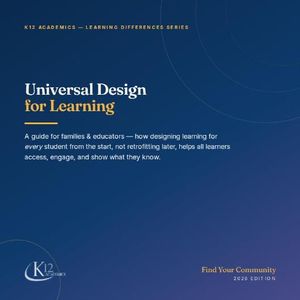
Universal Design for Learning (UDL) is a framework for building lessons that work for the full range of learners from the start — rather than designing for an “average” student and retrofitting fixes later. It rests on three principles, and it benefits everyone. This guide walks ten steps through it.
Step 1 of 10
What UDL Really Is
UDL is a framework for designing flexible learning that works for the widest range of students by design. Instead of one rigid path plus retrofitted accommodations, UDL builds in options from the start.
A framework — not a program
Flexible by design — options built in
For the range — not the “average”
How to help: Understand UDL as proactive design: anticipating learner variability and building in choices, rather than reacting to struggles one child at a time.
Good to know: There is no “average” learner — designing for the range from the start serves everyone better than designing for a myth.
Step 2 of 10
Know the Three Principles
UDL rests on three principles — offering multiple means of Engagement (the “why” of learning), Representation (the “what”), and Action & Expression (the “how”). Together they address why, what, and how students learn.
Engagement — the “why”
Representation — the “what”
Action & Expression — the “how”
How to help: Learn the three principles — they’re the lens for spotting where a lesson offers only one way in, and where it could offer more.
Good to know: The three principles map onto three brain networks (affective, recognition, strategic) — UDL is grounded in how people actually learn.
Step 3 of 10
Multiple Means of Engagement
The “why” of learning. Students engage differently, so UDL offers choice, relevance, and the right level of challenge — tapping motivation instead of assuming one thing motivates everyone.
Choice — in topics & tools
Relevance — connect to their world
Right challenge — not too easy/hard
How to help: Look for (or ask about) meaningful choices, real-world relevance, and goal-setting — the levers that turn compliance into genuine engagement.
Good to know: Motivation isn’t a fixed trait — the right choice or connection can switch on a “disengaged” learner.
Step 4 of 10
Multiple Means of Representation
The “what” of learning. Students take in information differently, so UDL presents content in more than one way — text, audio, visuals, video, hands-on — and makes key ideas and vocabulary clear.
Multiple formats — text, audio, visual
Clarify — key ideas & vocab
Options — not one-size-fits-all
How to help: Value teaching that presents information several ways — a concept explained, shown, and done sticks far better than one told once.
Good to know: Offering audio and text isn’t extra work for one child — it helps the whole class, and it’s how UDL works.
Step 5 of 10
Multiple Means of Action & Expression
The “how” of learning. Students show what they know differently, so UDL offers more than one way to demonstrate learning — write it, say it, build it, present it — plus support for planning and using tools.
Show it different ways — write, say, build
Support planning — organizers & steps
Allow tools — AT welcome
How to help: Look for flexible ways to demonstrate learning — so a dysgraphic child can present orally, and a quiet one can submit in writing, each showing real mastery.
Good to know: A single required format (always an essay) tests the format as much as the learning — options reveal what students truly know.
Step 6 of 10
Why UDL Helps Every Learner
UDL is designed for variability — the reality that every brain learns differently. Built-in options help students with disabilities, English learners, and “typical” learners alike. It’s good teaching, universally.
For variability — every brain differs
Helps all — not just disabilities
Just good teaching — universally
How to help: Support UDL knowing it isn’t “special” help for a few — it lifts the whole class, which is exactly the point.
Good to know: Like curb cuts and captions, UDL “accommodations for some” become improvements for everyone.
Step 7 of 10
UDL vs. Accommodations
Accommodations retrofit a fix for one student after the fact; UDL designs in flexibility from the start. They work together — but the more UDL a classroom has, the fewer individual retrofits it needs.
Accommodations — retrofit, per child
UDL — proactive, for all
Together — fewer retrofits needed
How to help: Value both, but recognize that a well-designed UDL classroom prevents many struggles before they need an individual accommodation.
Watch out: UDL doesn’t replace a child’s IEP or 504 — it reduces how often the whole class hits the same barrier.
Step 8 of 10
UDL at Home
You can borrow UDL thinking at home: offer choices, present information in more than one way, and let your child show what they know flexibly — it makes home learning work for how your child learns.
Offer choice — how & what
Multiple formats — read, watch, do
Flexible output — let them show it
How to help: Give your child real choices, use audio/visual/hands-on alongside text, and let them demonstrate learning in whatever way lets their understanding shine.
Good to know: UDL at home is mostly a mindset — “is there more than one way in, and more than one way out?”
Step 9 of 10
Ask Your School About UDL
You can advocate for UDL by asking good questions: how does the classroom offer choice, present content multiple ways, and let students show learning flexibly? Strong UDL benefits your child and everyone.
Ask about choice — and flexibility
Multiple formats — how is content shown?
Flexible assessment — more than one way?
How to help: Ask teachers and the school how they build in flexibility, and share that UDL supports your child without singling them out.
Good to know: Framing it as “what helps everyone” makes UDL an easy, positive ask — not a special request.
Step 10 of 10
The Mindset Shift
At heart, UDL flips a question. Instead of “what’s wrong with the student who can’t access this lesson?” it asks “what’s wrong with the design of a lesson only some students can access?”
Flip the question — design, not deficit
Barrier is the design — not the child
Fix the lesson — serve everyone
How to help: Adopt the core UDL mindset: when many students struggle with the same task, look first at the design of the task, not the students.
Good to know: The most powerful idea in UDL: the curriculum can be “disabled,” not the child — and curriculum can be redesigned.
Quick Reference
The Three Principles of UDL
UDL’s three principles — the framework in a nutshell, addressing why, what, and how students learn.
- Engagement — the “why”Multiple ways to spark and sustain motivation: choice, relevance, appropriate challenge, collaboration, and self-regulation support.
- Representation — the “what”Multiple ways to present information: text, audio, video, visuals, and hands-on, with key ideas, vocabulary, and background made clear.
- Action & Expression — the “how”Multiple ways to show learning: writing, speaking, building, presenting — plus support for planning, organizing, and using tools.
- The aim“Expert learners” who are purposeful and motivated, resourceful and knowledgeable, and strategic and goal-directed.
- The originUDL was developed by CAST, a nonprofit education-research organization, and is referenced in U.S. education law.
Official & Trusted Sources
Where to learn more
About this guide. This guide is general guidance. UDL is a framework, not a program — implementation varies. This guide is educational, for families and educators alike; work with your school on what UDL looks like in your child’s classrooms.